Psychosocial Risk Control
Keep frontline teams steady.
Echo calls frontline workers, listens for early signs of pressure, friction, and psychosocial risk, then gives supervisors practical actions before small issues become operational disruption.
The Problem
Two questions every organisation struggles to answer
Traditional tools — surveys, check-ins, toolbox talks — don't reach what's really happening. The risks stay invisible. The engagement stays unmeasured.
Pillar 1 — Risk
How do you control invisible risks?
Psychosocial hazards — workload pressure, grief, burnout, role conflict, personal crises bleeding into work — are the risks you can't see on a walk-around. They don't appear in incident reports until it's too late. By then, you're managing consequences, not causes.
- ▲ Elimination — not possible for psychosocial risk
- ▲ Substitution — not applicable
- ▶ Engineering Control — Echo is here
- ▼ Administrative Controls — surveys, policies, training
- ▼ PPE — EAPs, crisis counselling
✓ Echo controls invisible risks
Pillar 2 — Organisational Morale
How do you detect friction before it causes a breakdown?
Annual surveys measure last year's sentiment. Toolbox talks capture what people are willing to say in front of everyone. Neither reveals the invisible cognitive load or goal conflicts your workforce is navigating this week. Without real-time visibility, you miss the early warning signs of burnout, unplanned attrition, and safety incidents. Ignorance becomes an operational liability.
✓ Echo is your organisation's smoke alarm
The Echo Flywheel
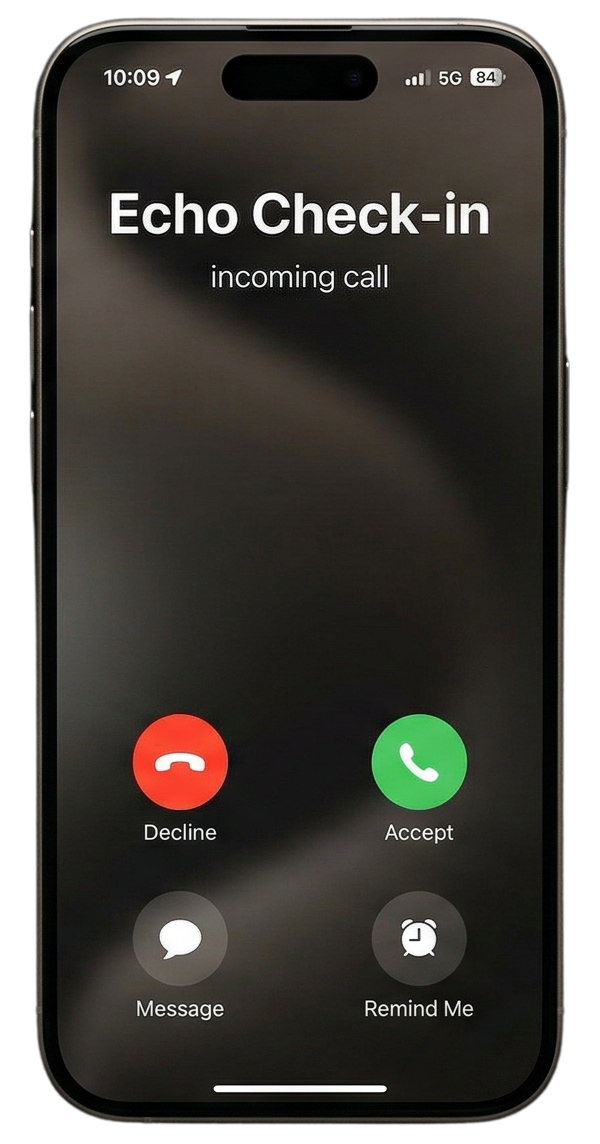
A phone call. Not another app.
Five steps from voice to evidence. No app, no login, no download. Echo calls your workers, extracts signal, delivers intelligence, closes the loop, and proves it to the board.
1
Check-in
Workers receive a scheduled voice call on their mobile. Conversations range from 2–20 minutes — adapted to whatever the worker needs that day.
2
Signal
Every call produces structured signal — themes, risk indicators, emotional context, and operational pressures — extracted from natural voice, never from scripts.
3
Insight
Managers receive a weekly Vibe Report — roster-aware, action-oriented, and specific. Workers receive a private monthly receipt of their own themes.
4
Action
Managers take specific, time-bound actions to manage risks and restore worker control. Every action is logged — receipt confirmed, taken, deferred, or dismissed.
5
Evidence
Boards receive proof of active risk control. The loop is closing. ISO 45003–aligned evidence packs are generated automatically, quarterly.
We don't need 100% participation. Like seismology, Echo triangulates the epicentre from partial data. 30–40% coverage + roster context is enough to find the risk. We don't need everyone to talk — we need enough signal to see the pattern.
Hear Echo in Action
We don't just transcribe words. We interpret the paralinguistic signals behind them. Experience how Echo detects burnout, fatigue, and focus risk from a short phone call.
Live signal demo
Marcus's 3-minute check-in, decoded.
Press play to hear the call and watch Echo translate voice, timing, and paralinguistic signals into risk intelligence in real time.
For Company Directors
Risk Governance: The Evidence That Defends You
Directors have a positive duty to actively manage psychosocial hazards. Passive controls achieve nothing. Echo establishes an undeniable audit trail that reduces the cost and distraction of both real and malicious psychological claims. When a claim arises, this evidence trail proves you executed active risk control across your workforce.
Positive duty means you must prove it. Under modern WHS frameworks (ISO 45003), "we didn't know" is not a defence. Directors need a system that actively surfaces risk and creates an auditable chain of evidence — from signal to action to outcome.
Detect
Signals detected from voice check-ins — human factor, psychosocial, operational.
Notify
Suggested actions sent to managers via the weekly Vibe Report.
Action
Manager acknowledgement — receipt confirmed, action taken, deferred, or dismissed.
Escalate
Risks that persist without resolution trigger escalation workflows.
Control Actions
Detected → Notified → Actioned → Verified| Action | Theme | Scope | Status | Owner | Evidence |
|---|---|---|---|---|---|
| Peak-time quality checkpoint added to Monday stand-up | Workload pressure | Team A | Verified | Team Lead | 📎 Stand-up notes |
| 1:1 with new starter re: onboarding support | Role transition | Individual | Actioned | Team Lead | 📎 1:1 log |
| Overnight shift buddy system for quality checks | Fatigue risk | Night crew | In progress | Ops Manager | — |
| Escalation: sustained personal strain flagged across 3 check-ins | Psychosocial | Cohort-level | Escalated | HR / WHS | 📎 Escalation log |
| Weekend coverage gap communicated — bridge shift proposed | Staffing | Site-wide | Notified | Ops Manager | — |
Every signal, notification, action, and escalation is timestamped and attributed. Board-level evidence packs are generated automatically. This is the core proof of "reasonably practicable" risk control for regulators, defending against frivolous claims and protecting your managers.
The Cost of Inaction
$67,400 | 36 weeks | +161%
Psych claims are the fastest-growing cost on your workers' compensation register — and the hardest to defend without evidence of active control.
Source: Safe Work Australia, 2023–24
Top Causes of Claims (2023–24)
- Harassment & workplace bullying 33.2%
- Work pressure 24.2%
- Exposure to violence 15.7%
✓ Echo actively tests for each of these risk categories — every call, every worker, every week.
Safe Work Australia index
Index of serious claims by nature — 2013–14 to 2023–24p
For Operations Leaders
Operational Stability and Governance
You're caught in the middle: held accountable for throughput and turnover, but relying on lagging exit interviews and injury reports. Echo's Cohort Vibe Report cuts through the noise. Every Monday morning, you see exactly which sites are steady, which managers are struggling to support their teams, and what operational blockers need your immediate attention.
Insights @ Echo <insights@echo-control.com>
Operational Cohort Report — 5 Sites · 420 workers · 2 critical escalations
Operational Pulse: Status Check
🟢 Steady (3 Sites)
Running smoothly. Local managers are handling issues themselves.
Brisbane, Perth Ops, Sydney South
🟡 Strained (1 Site)
Feeling the workload pressure, but the manager is on top of it.
Melbourne Metro (Manager Action: 85%)
🔴 Critical (1 Site)
High burnout risk. The manager is missing the warnings and needs your help.
Perth Logistics (Manager Action: 12%)
Your 2-minute move:
Call the Perth Logistics Manager. Their team is struggling, and they are only actioning 12% of their alerts. Ask: "Are you drowning in volume? How can I help you clear the backlog today?"
For HR / People Ops
Stop Taking the Temperature. Start Diagnosing the Fever.
Generic surveys were the only tool available to HR — until now. Echo upgrades your capability from reacting to lagging "engagement scores" and individual complaints, to proactively predicting operational friction. Support the core business by detecting what workers are actively trying to control this week.
Generic Survey Tools
"Score workers against predefined drivers"
Annual or pulse surveys ask workers to rate dimensions chosen by the tool vendor. Results are aggregated into heatmaps. You're comparing yourself to peers on a low-resolution scorecard that may not reflect what your people actually want.
Echo
"Detect what workers are actually trying to control"
Echo listens to what workers say, not how they score. It detects what they actively care about, what's disturbing them, and how they're compensating — in their own words, at the resolution of the individual.
Grounded in Perceptual Control Theory (PCT). Echo's engagement model is built on PCT — the science of how people act to control what matters to them. Instead of scoring workers on vendor-defined drivers, Echo detects what each person is actively behaving to control, what is disturbing that control, and how they are compensating. This is why the data is specific, localised, and actionable — not abstract heatmaps.
Read the whitepaper →For Managers
Your Team's Week, Decoded
Echo doesn't coach you — it gives you a cheat sheet. Every week, the team manager receives a roster-aware Vibe Report by email — structured intelligence from unstructured voice, translated into clear actions (your "2-minute moves"). Echo surfaces suggested actions so you spend less time diagnosing and more time doing. You're not a therapist — your job is to acknowledge the friction and act on the pre-built 2-minute move.
Insights @ Echo <insights@echo-control.com>
Weekly Vibe Snapshot — Your team · 12 of 14 enrolled · 3 suggested actions
Weekly Vibe Snapshot – Your Team
Coverage: 12 of 14 enrolled team members had a call this fortnight for 16 conversations total.
Status: Engagement and commitment are strong across those who checked in, but the team is running on thin margins with personal and work pressures pulling in multiple directions.
Main risk this week
Emotional load from personal circumstances and constant interruptions are fragmenting focus, increasing the chance of missed steps in handoffs and client-facing work.
If you do one thing this week:
In your next team huddle, ask: "Who has a task this week where interruptions could cause something to fall through the cracks — and what would help you protect that one thing?" Act on the first answer you get, even if it is small.
What Echo is hearing — Work-related
- Constant inbound demands and competing priorities are still breaking up focus time. Several people described being unable to concentrate on priority tasks because of interruptions, and at least one is trying to carve out protected windows in the morning to get ahead of the day.
- Recognition and communication gaps are surfacing as friction points. One team member described low morale tied to a lack of acknowledgment despite hitting goals. Another is actively seeking more regular contact with their manager to get clarity on future direction and goal-setting.
- Where satisfaction was rated, scores remain high. People care about the work and want to do it well — capacity and interruptions are the constraint, not motivation.
What Echo is hearing — Human factor load
- Personal load remains high across the group — a pattern that has persisted across multiple fortnights. Several people are managing significant personal circumstances alongside work while keeping work on track.
- One team member is navigating a difficult personal situation while handling emotionally charged client calls. They are proactively setting boundaries, but a small additional demand could tip the balance.
- The shift-transition strain flagged in previous weeks is still present. At least one person described the adjustment as limiting their ability to engage in activities that matter outside work.
Signals worth watching
- Morale and recognition gap: One team member described feeling undervalued and mentioned colleagues feel the same way. When engaged people start thinking about the exit, it usually shows up first as reduced discretionary effort.
- Two team members could not be reached across multiple attempts: Without a conversation, there is no read on how they are tracking — worth a brief check-in from you to close the gap.
Options for this week
These insights are based on anonymised patterns from Echo calls. No individual conversations or names are shared.
Scroll inside the email to read the full Weekly Vibe Snapshot
For Workers
Be Heard. Stay Safe. Keep Moving.
Echo is a guide, not a therapist. A friendly ear, not your new best friend. It helps you clear your head, find your next step, and move on with your day. The conversation is always in your control.
1. The Fast Check-In
"All good, nothing to report." Documented, and the call wraps up quickly.
2. The Pulse Check
A brief 2–5 minute conversation about any operational, psychosocial, or personal friction you're currently navigating.
3. The Deep Dive
Spend up to 20 minutes reorganising your thoughts to gain clarity. Like renting a "2nd brain" for a nagging issue.
You leave each call with closure, a next step, and a private monthly receipt. Click below to see an example.
Echo <hello@echo-control.com>
Your monthly check-in receipt — Keep your day intact — even when the calls keep cutting in
Keep your day intact — even when the calls keep cutting in
Hi — this is a quick recap of what you've been working through: system reliability work alongside a program rollout. It makes the next Echo check-in faster because you can jump straight to the one friction point you named: interruptions from calls.
IN ONE BREATH
- Focused on: keeping a reliability-critical system steady while pushing a rollout to a new team.
- Gets in the way: interrupting calls chopping up your focus when you're trying not to miss details.
- Helps: quick, no-fuss check-ins where you can end early once you've named what matters.
Your last receipts
Reliability day — 11 Mar
What mattered: keeping a system reliable while you were heads-down on the work.
Friction: interrupting calls pulling you off-task mid-flow.
What helped: keeping the check-in brief and choosing not to add extra steps when you didn't want them.
Rollout grind — 4 Mar
What mattered: a long day pushing a program rollout to a new team, with the usual pre-rollout snags.
What helped: calling it when you'd covered the essentials instead of dragging the check-in out.
Deadline juggle — 25 Feb
What mattered: coordinating a delivery due in the next 24 hours, making sure nothing slipped.
What helped: keeping track of multiple moving parts while staying on top of what needed doing first.
Pattern + delta
Pattern: you do fine with heavy delivery work (rollout + deadlines), but your focus gets sliced up when calls land during reliability-critical tasks.
Shift since last time: the earlier check-in was about juggling a near-term delivery; the newest one zeroed in on protecting uninterrupted time because the calls were the main drag.
TINY WIN TO KEEP
You clearly named the one thing that was breaking your flow (interrupting calls) and kept the check-in tight instead of adding more to your plate.
Next time Echo calls...
This check-in helps you protect a clean block of focus while you're balancing reliability work and rollout demands.
Your 2-second opener
“Quick one: the calls keep interrupting my reliability work, and I want a clean focus block today.”
- One practical way to stop mid-task calls from derailing the next hour.
- What to keep from your "keep it brief, end early" approach when the day runs long.
- The single deliverable you don't want to miss while rollout details multiply.
When Echo calls, you can keep it short. Start with the opener above.
Optional, private, no scores. Yours to share or keep.
Scroll inside the email to read the full monthly check-in receipt
For IT & InfoSec
Zero Integration to Start. Enterprise Security to Scale.
We know IT resourcing is tight. Echo makes your life easy. You can launch a pilot with absolutely zero technical integration. No app to deploy, no download for workers, and no complex SSO integration required.
Phase 1 — Frictionless Launch
Start without the IT bottleneck
Pilot Echo using a simple secure file transfer (SFTP) or manual roster upload. Workers receive a standard phone call. No mobile device management (MDM) profiles to configure, no passwords for workers to lose.
Phase 2 — Deep Analytics
Layer in integrations as needed
Once value is proven, connect Echo seamlessly to your existing HRIS, Shift Management, and ERP systems (e.g., Workday, UKG, Kronos). This contextual data strengthens the Vibe Report's risk awareness without disrupting operations.
Enterprise-ready security controls. We treat data privacy as our primary currency. Our architecture enables strict data geography controls and tenant isolation today. We actively partner with enterprise adopters to formalize our ISO 27001 and SOC 2 posture against their specific compliance thresholds. All voice data is anonymised by design.
What Echo Does
Proven in Production
Every capability below has been demonstrated with real workers, on real calls, over extended pilot deployments in live environments.
Voice Check-in Calls
Outbound calls on a scheduled cadence. No app, no download, no login.
Memory & Continuity
Echo recalls previous conversations without being prompted, building a genuine relationship over time.
Live Call Rescheduling
Workers reschedule live during the call. Echo books, confirms, and follows through.
Short & Deep Conversations
Calls range from 1 to 20 minutes. The agent adapts to worker-led depth.
Weekly Vibe Report
Structured intelligence from unstructured voice: roster-aware, action-oriented, weekly.
Worker Reflection Receipts
Private monthly summaries of their conversations — something tangible back from every call.
Socratic Deep-Dive
Open-ended questions for cognitive clarity, not just empathy. Workers leave with a next step.
Big-5 Spirit Animal
One-time psychometric assessment personalises Echo and powers team-level compatibility analysis.
Pricing & ROI
Compliance That Pays for Itself.
Most compliance tools are a cost of doing business. Echo is the rare exception — a psychosocial risk control that delivers a positive return on investment.
$67,400
Median psychological claim payout
Source: Safe Work Australia, 2023–24
Your Estimated Annual Exposure
Adjust the profile, headcount, and realised incident costs to model the annual cost of inaction against Echo's estimated subscription cost.
Estimated Annual Costs of Inaction
~1
Est. claims / year
$18K
Premium impact1
$17K
External legal & HR2
$135K
Avoidable turnover
$48K
Excess absence cost
Your Realised Costs
per incident × claims, adjust to fit
Cost of Doing Nothing
$283K
claims + turnover + absence + realised
With Echo — You Save
$133K
estimated net annual savings after subscription
Echo delivers $1.89 for every $1 invested.
Premium impact: $15–20K uplift per serious claim (Business NSW, 2024). Legal includes rejected claim defence (acceptance rate 68–69%, Safe Work Australia). Turnover: 18% churn, 10% reduction, $15K replacement. Absence: 4 excess days, 8% affected, $300/day.
A redundant worker brings a post-hoc psychological claim against the company. Click to expand →
Without Echo: The classic “he-said, she-said.” The employer faces a heavy legal burden because they cannot produce evidence of safe work design over the preceding 12 months. An expensive settlement is highly likely.
With Echo: The audit trail proves the employer actively provided a safety control. Evidence shows the worker either generated no risk signals, had their issues resolved safely by their manager, or failed to engage in good faith.
What People Ask
We've Heard the Hard Questions. Here Are the Answers.
Every new approach meets resistance. These are the most common concerns we hear — and why they don't hold up.
🔒 "My boss is listening to my calls. This is a spy tool." ⌄
Managers never hear raw audio. They only see aggregated cohort trends. Cohorts below 7 people are suppressed entirely to protect anonymity.
Echo is a filter, not a microphone. It blocks your identity but amplifies your message.
🤖 "Talking to a robot is weird. It won't understand nuance." ⌄
Workers consistently rate the agent 5/5 for trust and report feeling “heard” and “understood”. It remembers previous conversations, asks open-ended questions, and gives space to think without judgement.
“It almost felt like I was talking to a real person.” — actual worker feedback.
⏳ "I'm busy. I don't have time for another survey that goes nowhere." ⌄
Echo is a short voice check-in that replaces long surveys, and it gives instant value back to the worker via the Reflection Receipt — tracking your momentum and clearing your head.
This isn't a survey for HR; it's a tool for you. The “2-second opener” makes the next call frictionless.
📥 "I'm already drowning. I don't have time to analyse data and fix everyone's problems." ⌄
Echo saves time by identifying the “One Thing” to focus on and automating the follow-up loop. It tells you exactly who needs help and what to do.
Echo doesn't give you more work; it gives you a cheat sheet. The Weekly Vibe Report does the thinking so you don't have to guess.
🙅 "Our guys are tough — they won't talk to a machine." ⌄
We consistently see ~50% enrolment and ~70% fortnightly coverage where participation is voluntary. Voice-first is easier than typing. And 40% coverage is more than enough to triangulate team-wide risks.
It's not an optional survey; it's a safety system. Like PPE or pre-starts, it becomes part of the job.
🚪 "Can people opt out of taking the calls?" ⌄
In high-risk environments, we recommend treating Echo like a pre-start check or Job Hazard Analysis. Taking the call is mandatory, but what the employee talks about is entirely up to them. In lower-risk environments focused purely on engagement, participation can be entirely voluntary.
You mandate the safety process, but the worker controls the conversation.
🎲 "People will just game it to get what they want." ⌄
There is no incentive to game a safety system. There are no scores, no rankings, no consequences tied to individual responses.
You don't game a smoke alarm. The only “win” is a safer, more stable workplace.
📢 "They'll just complain about pay and rosters that we can't change." ⌄
“Whinging” is often just a need to be heard. Wilful ignorance is worse than knowing and acknowledging. Even if you can't fix the roster today, acknowledging the friction builds trust.
Knowing is better than guessing. Echo allows you to be precise with the actions you can take.
⚖️ "If we know about a risk and don't fix it, we're liable." ⌄
Regulators punish negligence and ignorance, not active control attempts. In the eyes of the law, it is far better to be actively controlling a risk and failing than to be quietly ignorant and succeeding.
Echo is your evidence of “reasonably practicable” steps. The audit trail proves you're doing the work — not hoping for the best.
Ready to see what Echo hears?
Book a walkthrough of the platform. We'll show you a live demo, walk you through the Vibe Report, and answer every question on your list.
What Workers Say
Rated 5/5 for Trust. Consistently.
Real feedback from real workers — anonymised, unedited. Every quote below is from a voluntary post-call survey.
"It almost felt like I was talking to a real person. I was driving when I took his call, and he was aware of this. He even took the initiative to schedule a follow-up call later this week, which I really appreciated."
★ 5/5 Trustworthiness
"His clarity questions and curiosity had me reach a new level of insight."
★ 5/5 Trustworthiness
"I LOVED my call — he's so sweet. It's super important to leave someone with a 'next step' rather than just being heard and acknowledged."
★ 5/5 Trustworthiness
"Very cool that he remembered to recap our last call — without me asking."
★ 5/5 Trustworthiness
"This call felt more 'human' and so felt like I was really heard in this call."
★ 5/5 Trustworthiness
"I almost feel like he was aware that I didn't need a call longer than I needed which was super cool."
★ 5/5 Trustworthiness
"The Weekly Vibe Report confirms my intuitions and makes me more confident in the actions I take with the team."
📋 Area Manager
"I have a large and growing team — I can't be everywhere at once. Echo helps me direct my attention to where it's needed most."
📋 Area Manager